
Overview
How permanent magnets fit the application
Permanent magnets establish the working field in brushless motors, generators, alternators and compact actuators. The best material is not automatically the grade with the highest surface field: the magnetic circuit, rotor speed, temperature rise and expected fault conditions determine what will remain stable in service.
Start with the hottest temperature at the magnet, including winding heat and short-duration overloads. Then evaluate the magnet's working point in the assembled circuit. A thin segment in an open magnetic path can demagnetize sooner than a thicker magnet of the same grade.
Specify the system
Selection factors to define first
Maximum magnet temperature during continuous duty and fault conditions
Air gap, back iron and the magnet's load line in the assembled circuit
Rotor speed, retention method and allowable balance variation
Cogging, torque ripple and the required magnetization direction
Material options
Magnet types commonly considered
These are starting points, not universal prescriptions. Temperature ratings and field performance depend on magnet geometry and the complete magnetic circuit.
N42SH or N45SH neodymium
Strong fields in compact motors where magnet temperature stays near or below 300°F / 149°C.
Read the material guideSm2Co17 samarium cobalt
Better temperature stability, corrosion resistance and margin for hotter continuous-duty machines.
Read the material guideN52 neodymium
High room-temperature flux when thermal margin and circuit permeance are well controlled.
Read the material guideGeometry
Useful shapes to compare
Stocked reference points
Representative magnets for evaluation
These individual sizes are useful physical reference points. Final selection should be checked against the required field, force, temperature and safety constraints.
N45SH block, SKU 2010
A 1 × 0.25 × 0.25 in / 25.4 × 6.35 × 6.35 mm geometry for fixture and rotor concept work.
N45SH disc, SKU 2027
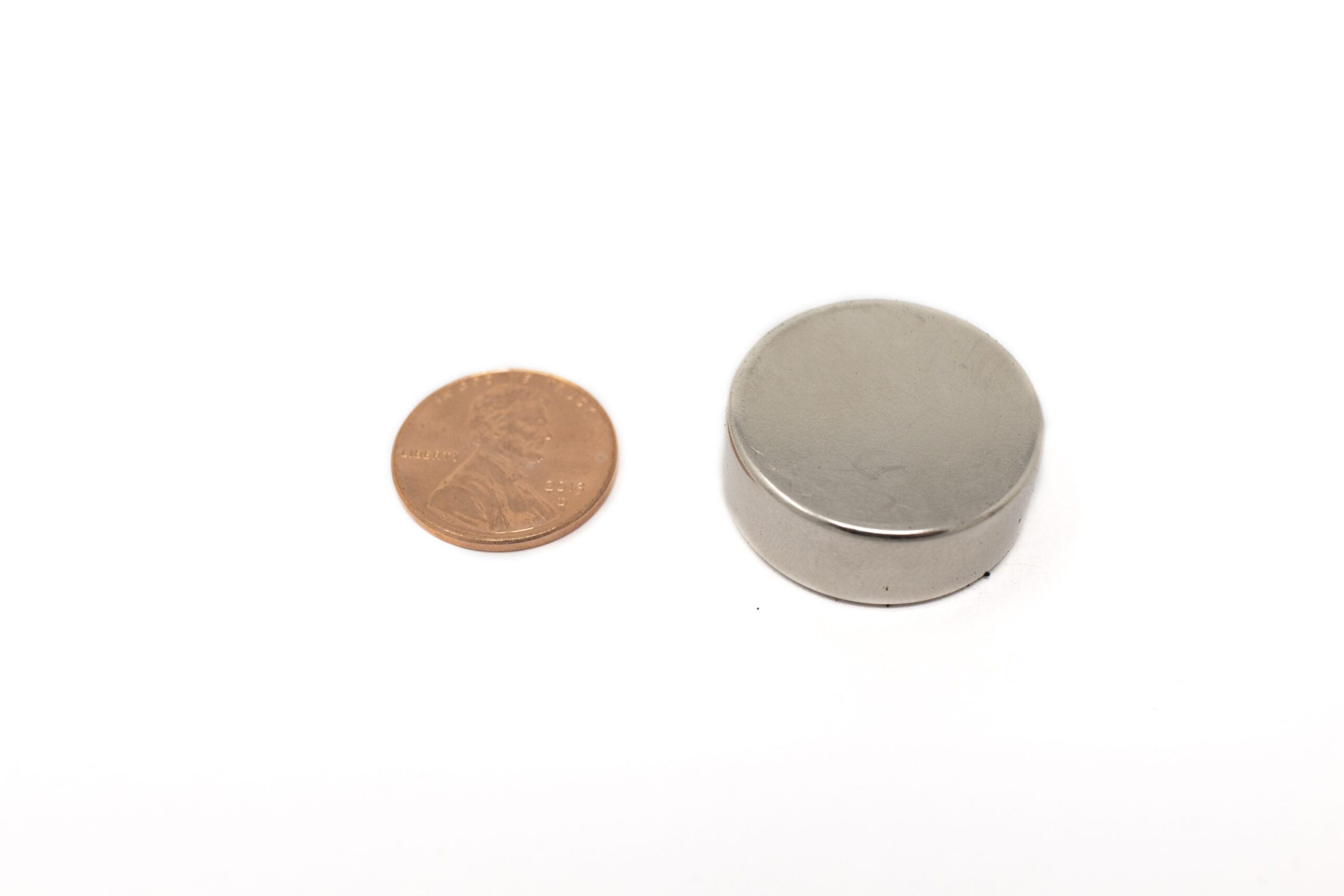
A 1 in / 25.4 mm diameter disc for axial-field evaluation at elevated temperature.
Sm2Co17 block, SKU 2004
A 550°F / 288°C-rated example when thermal stability matters more than maximum energy density.
Design and safety notes
- Do not select a grade from ambient temperature alone; estimate or measure temperature at the magnet.
- Mechanical retention must account for centrifugal force, adhesive aging and differential thermal expansion.
- Confirm pole orientation and magnetization direction before tooling or ordering production quantities.