
Overview
How permanent magnets fit the application
Permanent magnets provide bias fields in circulators, isolators, microwave tubes, beam steering, laboratory instruments and other RF systems. These applications often care more about predictable field over temperature and time than maximum room-temperature pull force.
Samarium cobalt is widely considered when low reversible temperature coefficient, corrosion resistance and elevated-temperature stability justify its lower energy product. Field homogeneity remains a circuit-level problem involving pole pieces, gaps, shims and surrounding magnetic materials.
Specify the system
Selection factors to define first
Required field magnitude, direction and homogeneity in the active volume
Allowed reversible change across the instrument's temperature range
Long-term stability, calibration interval and exposure to demagnetizing fields
Vacuum, corrosion, cleanliness and outgassing requirements of the complete assembly
Material options
Magnet types commonly considered
These are starting points, not universal prescriptions. Temperature ratings and field performance depend on magnet geometry and the complete magnetic circuit.
Sm2Co17 samarium cobalt
A common choice for stable bias fields, high temperature and uncoated corrosion resistance.
Read the material guideN42SH or N45SH neodymium
Higher energy density when thermal behavior is modeled and environmental protection is suitable.
Read the material guideN42 or N45 neodymium
Laboratory fixtures and room-temperature prototypes where compact field strength is the priority.
Read the material guideGeometry
Useful shapes to compare
Stocked reference points
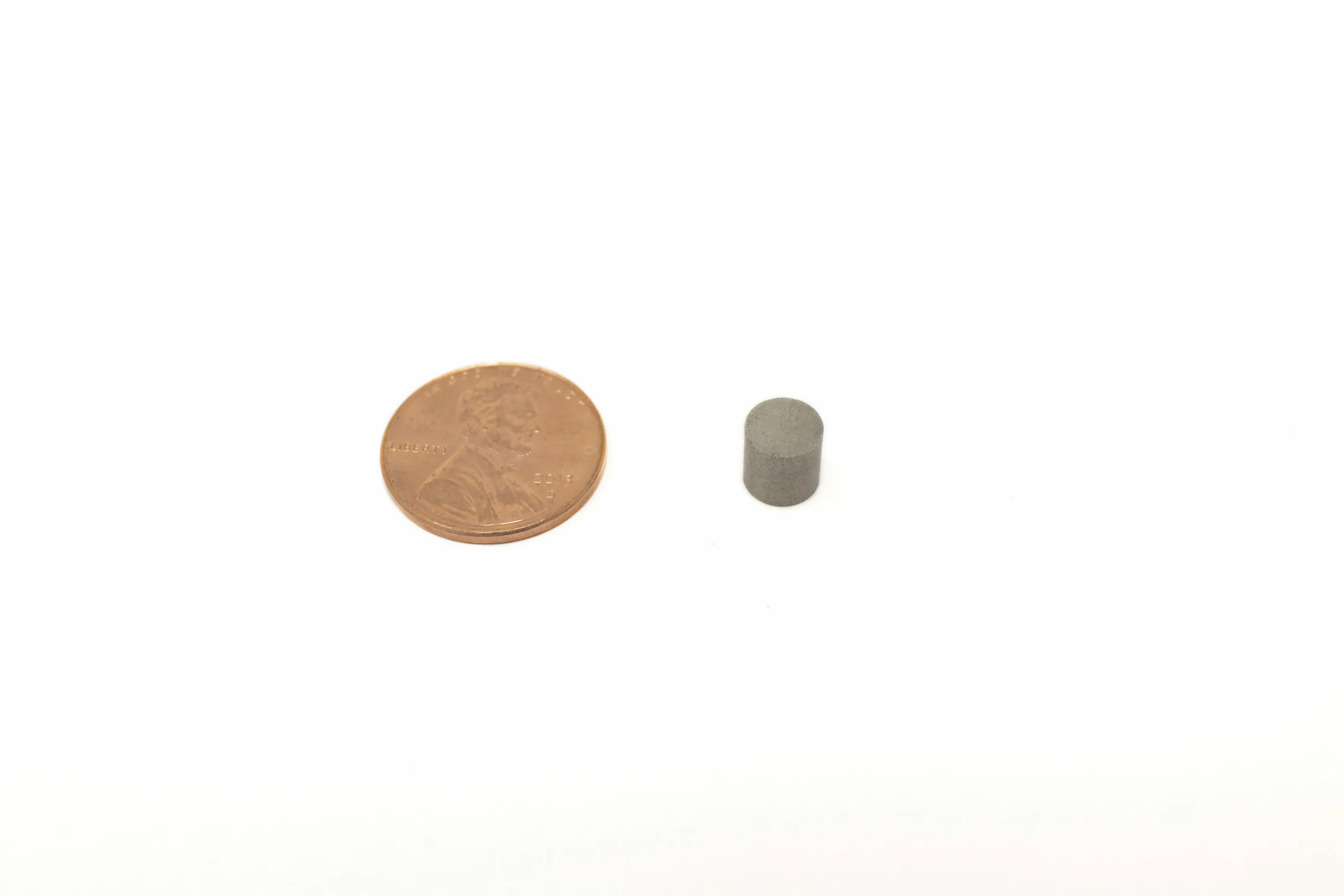
Representative magnets for evaluation
These individual sizes are useful physical reference points. Final selection should be checked against the required field, force, temperature and safety constraints.
Design and safety notes
- Specify field in the active volume and at operating temperature, not only at the magnet surface.
- Use pole pieces and shimming to tune homogeneity after the overall magnetic circuit is defined.
- Confirm vacuum, cleanliness and material restrictions for the finished assembly separately from magnetic performance.