
Overview
How permanent magnets fit the application
Magnetic sensors translate field strength or direction into position, speed, current or proximity data. Repeatability depends on more than nominal magnet grade: dimensional tolerance, magnetization angle, working distance and surrounding steel can move the signal enough to affect calibration.
Define the sensor's required field window across the full travel and temperature range. A small, consistent magnet located correctly is usually more useful than an oversized magnet that saturates the sensor or produces a steep, alignment-sensitive field gradient.
Specify the system
Selection factors to define first
Minimum and maximum field at the sensor across the complete motion envelope
Magnetization direction, pole-position tolerance and allowed angular error
Air gap variation caused by assembly tolerance, wear and thermal expansion
Nearby ferrous parts, currents and magnetic sources that distort the field
Material options
Magnet types commonly considered
These are starting points, not universal prescriptions. Temperature ratings and field performance depend on magnet geometry and the complete magnetic circuit.
N42 or N45 neodymium
Compact sensing at ordinary temperatures with a broad range of stock geometries.
Read the material guideN42SH or N45SH neodymium
Added coercivity for sensors mounted near motors, engines or heated process equipment.
Read the material guideSm2Co17 samarium cobalt
Stable output over wide temperature swings and good uncoated corrosion resistance.
Read the material guideGeometry
Useful shapes to compare
Stocked reference points
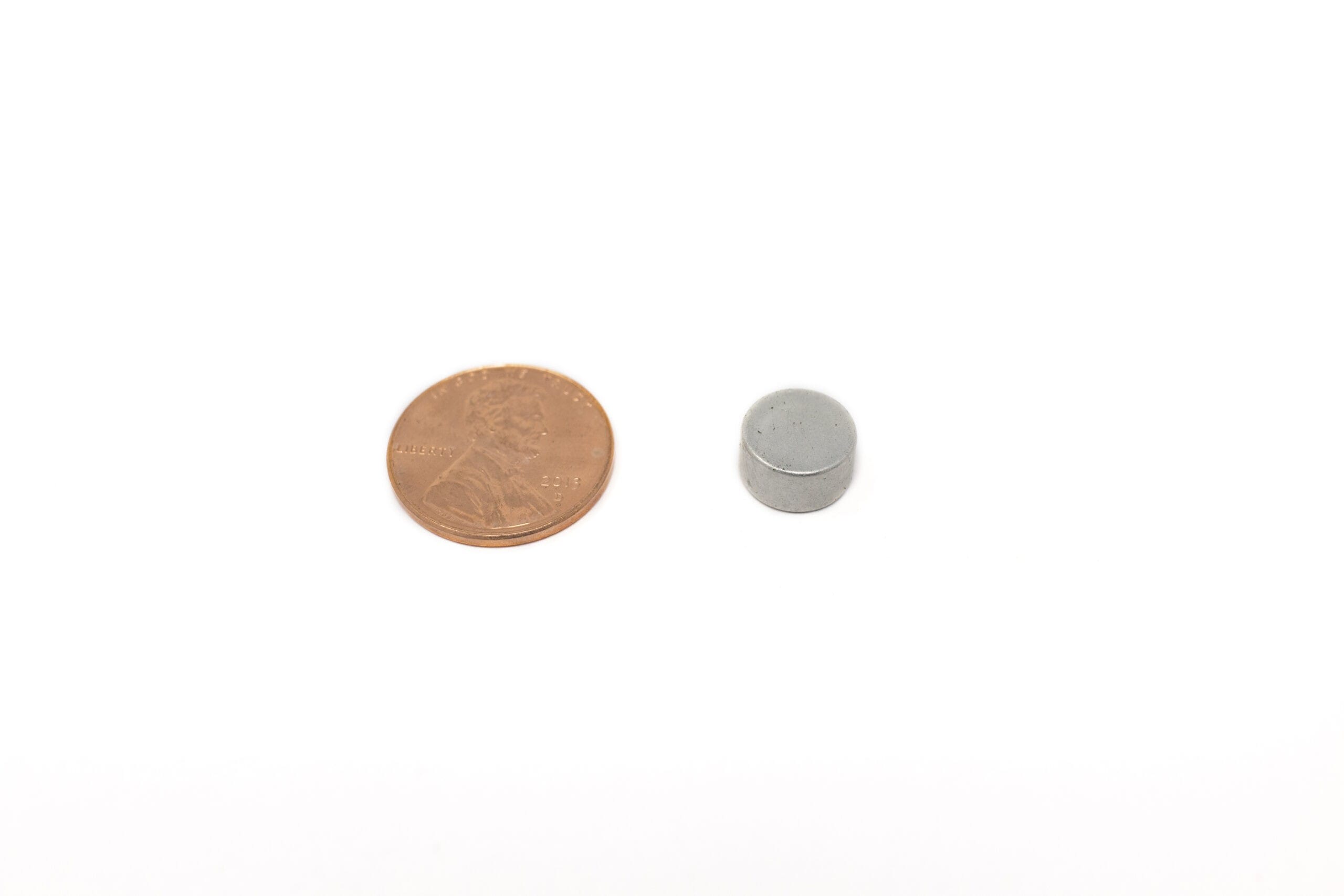
Representative magnets for evaluation
These individual sizes are useful physical reference points. Final selection should be checked against the required field, force, temperature and safety constraints.
Design and safety notes
- Prototype at the real working gap and with the final steel hardware present.
- Specify polarity marking and magnetization orientation on the drawing, not only in purchasing notes.
- Characterize the complete sensor transfer curve instead of relying on surface gauss alone.