
Overview
How permanent magnets fit the application
Magnetic couplings transfer torque across an air gap or nonmagnetic containment wall, allowing a motor to drive a sealed pump or mixer without a rotating shaft seal. Magnetic bearing arrangements can reduce contact and wear, but they require careful mechanical constraint because permanent magnets alone do not provide passive stability in every axis.
The working gap dominates performance. Container wall thickness, coatings, misalignment and assembly tolerance should all be included when estimating torque. Thermal and chemical exposure often make samarium cobalt attractive even when a neodymium design is smaller.
Specify the system
Selection factors to define first
Required starting, running and overload torque at the largest credible gap
Containment-wall material, thickness and pressure requirements
Fluid temperature, corrosion exposure and cleaning process
Radial and axial restraint, misalignment and safe decoupling behavior
Material options
Magnet types commonly considered
These are starting points, not universal prescriptions. Temperature ratings and field performance depend on magnet geometry and the complete magnetic circuit.
Sm2Co17 samarium cobalt
High-temperature, wet or chemically demanding couplings with low long-term drift.
Read the material guideN45SH neodymium
High torque density with useful thermal margin in compact industrial assemblies.
Read the material guideN52 neodymium
Maximum room-temperature coupling density when corrosion and heat are controlled.
Read the material guideGeometry
Useful shapes to compare
Stocked reference points
Representative magnets for evaluation
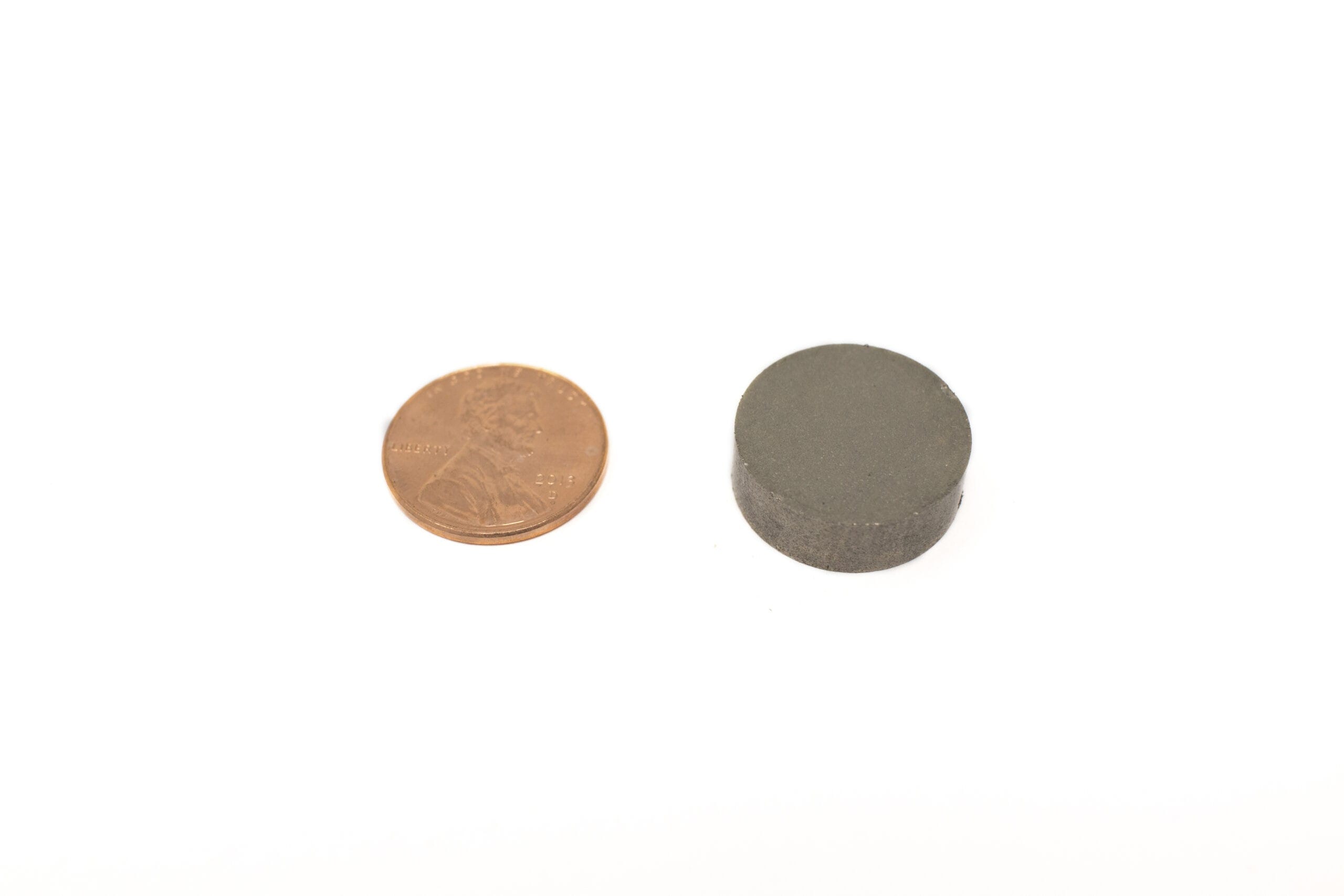
These individual sizes are useful physical reference points. Final selection should be checked against the required field, force, temperature and safety constraints.
Design and safety notes
- Model or test torque at the maximum gap, not the nominal assembly dimension.
- Provide mechanical guarding for sudden decoupling and re-engagement under overload.
- Treat magnetic bearings as part of a constrained mechanical system, not a stand-alone suspension solution.